










Breaking News
 Joe Rogan Experience #2574 - Francis Foster & Konstantin Kisin
 Joe Rogan: "I think something's about to go down."
 Whether Bibi Stays or Goes, the 'Special Relationship' Must End
 The EU Met Its Waterloo in Warsaw
Top Tech News
 PRP vs Exosomes vs Stem Cells: Which Fits Your Condition?
 SHOCKING: The Secret (Frantzve) Family Business
 Microreactor Gets DOE Approval for Full Power Testing, Previously Contracts with Army...
 Ford Fathom: Everything We Know About The Sub-$30,000 Affordable EV Truck
 Love it or loathe it, AI is birthing a golden age of science
 SpaceX has no competition -- Saurav Shroff, Starpath
 Living computers forge a 'hive mind' and work together to outsmart AI
 The Faraday duffle bag: A digital lifeline in a surveillance-saturated world
 Delivery Robots Accused Of Scanning Customers' Faces, Sharing Biometric Data
 FDA-Approval for Drill-Free Cavity Care May Be Imminent After Great Phase 3 Treatment Trial



Whether Bibi Stays or Goes, the 'Special Relationship' Must End
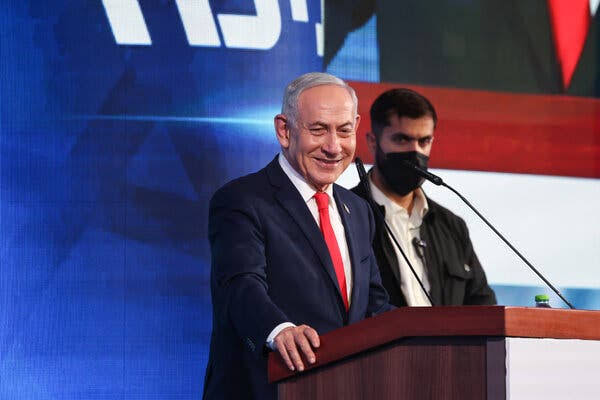
Israelis have voted in their first election since the attacks of October 7 and the ensuing war in Gaza. The poll was widely seen as a referendum on Benjamin Netanyahu, and while the prime minister's opponents appear to have denied his coalition an outright majority, pro-Netanyahu parties won several more seats than the Jewish anti-Netanyahu grouping (at least as of this writing; precise results are still in flux). The balance is held by the two Arab parties, who, being Netanyahu opponents, should make for natural allies of the Jewish opposition bloc—except that, being Arabs, their participation in any coalition is a matter of intense controversy.
Viewed from the United States, all this is interesting. Israel's electoral system is quite different from our own, and its politics is famously convoluted and unpredictable. (Get two Israelis talking across a table, an IDF colonel once told me, and you will hear three opinions.)
But there are also, unfortunately, vital stakes for us here. For the plain fact is that the Israeli government exercises tremendous influence over U.S. foreign policy. For decades, the concerns and priorities of Israel have played an outsize role in keeping America militarily engaged in the Middle East. Eight months ago, we saw the risks of this metastasize spectacularly when our government launched a ruinous and illegal Mideast war "at the request of and in the collective self-defense of its Israeli ally" (to quote from the State Department's own legal rationale for the conflict). Nor is this influence limited to external affairs: The Israel lobby is a significant, if weakening, force in our domestic politics, which retains considerable ability to sway election outcomes. (Just ask Thomas Massie.)
So for Americans, it matters who leads this small country 6,000 miles away, and I would submit we have a rooting interest in a leader prevailing who is not named Benjamin Netanyahu. But the vastly more important issue is the fact that this matters. The problem with the "special relationship" between America and Israel is bigger than one man.
This is not to say that things wouldn't be better for everyone with Netanyahu gone. Indeed, his conduct in the run-up to the vote showcased the Israeli premier's singular ruthlessness and his willingness to set the entire region ablaze if it could benefit him politically. Last week, Netanyahu ordered Israeli warplanes to fly near Iranian airspace, apparently in the hopes that Iran would open fire and supply a pretext for a renewal of the war. Then, the weekend just before the vote, he reportedly issued a directive to the IDF to launch unspecified military action against Iran, which appears to have been thwarted thanks to heroic resistance by the military's chief of staff. Netanyahu also leaned into increasingly desperate fearmongering in the last days of the campaign, sharing hysterical warnings about the imminent disaster his loss would bring about (notably including a post that depicted a mushroom cloud over Tel Aviv and suggested Israelis who voted against him would be "condemning themselves and their family to the danger of a second Holocaust").