










Breaking News
 Amazon Boeing Plane Bursts Into Flames After it Overshoots Runway at Miami International Airpot
 Trump grants clemency to 30 people, White House pardon czar says
 Bessent: "CUT THE SNAKE'S HEAD OFF"--But Who is the Real Target?
 Special LIVE Saturday Show: Could The Gov Seize XRP After Chilling FDIC Admission? Gas Prices...
Top Tech News
 Floating data center would provide water and electricity to 32,000 homes
 OpenAI Cuts Off Elon's Cursor, Humanity's First Star Probe, and Trump's Nuclear Mars Shi
 Eating pollution? Plastic-to-cookie technology raises safety, environmental concerns
 Ford's $30,000 Fathom EV Truck Appears More Conventional Than Expected
 Berlin-based artist Simon Weckert explored that idea with Digital Camouflage...
 Tether expands tokenization business into Saudi Arabia, starting with real estate
 Ukraine is facing a new problem in its war with Russia:
 It charges more than it discharges while driving
 Dataminr AI tech to go live on NATO Maven system: CEO
  The Most Dangerous Interview Ever Recorded? PART 2


Bezos will work with NASA, ESA to create moon base
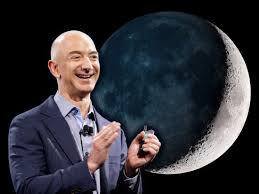
Jeff Bezos says his Blue Origin space venture will work with NASA as well as the European Space Agency to create a settlement on the moon.
Even if Blue Origin can't strike public-private partnerships, Bezos will do what needs to be done to make it so, he said here at the International Space Development Conference on Friday night.
Bezos laid out his vision for lunar settlement during a fireside chat with Alan Boyle, which took place just after he received the National Space Society's Gerard K. O'Neill Memorial Award.
In the short run, Blue Origin's objective is to reduce the cost of access to space — initially with its New Shepard suborbital spaceship, and then with its orbital-class New Glenn rocket in the 2020s.
In the long run, Bezos' vision is to smooth the way for millions of people working in space. Those people just might live and work in hollowed-out asteroids — a concept that was proposed decades ago by O'Neill, a Princeton physicist whose ideas on space settlement fueled Bezos' passion for the final frontier.