










Breaking News
 Why Are You Gay? Milo Yiannopoulos Explains.
 Futuristic dome grows food by itself – with help from some fish
 Why Families are Leaving Government Schools: Cultural Shifts and Civic Solutions
 Trump DOJ Sides With Roundup Manufacturer Over Cancer Victims in Supreme Court Case
Top Tech News
 Build a Greenhouse HEATER that Lasts 10-15 DAYS!
 Look at the genius idea he came up with using this tank that nobody wanted
 Latest Comet 3I Atlas Anomolies Like the Impossible 600,000 Mile Long Sunward Tail
 Tesla Just Opened Its Biggest Supercharger Station Ever--And It's Powered By Solar And Batteries
 Your body already knows how to regrow limbs. We just haven't figured out how to turn it on yet.
 We've wiretapped the gut-brain hotline to decode signals driving disease
 3D-printable concrete alternative hardens in three days, not four weeks
 Could satellite-beaming planes and airships make SpaceX's Starlink obsolete?
 First totally synthetic human brain model has been realized
 Mach-23 potato gun to shoot satellites into space


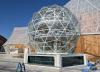
Futuristic dome grows food by itself – with help from some fish
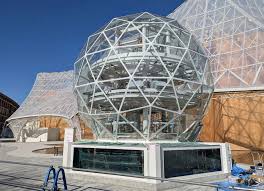
Think of it as a tiny house of produce.
Known as "Inochi no Izumi" (??????), or "Source of Life," the dome became one of the standout pieces of ingenuity on show at the Osaka Health Pavilion on Yumeshima Island. The 6.4-m-high (21-ft), 7-m-diameter (23-ft) dome, built to symbolize the Earth, sits atop a base containing four different water zones that provide the living engine of this closed-loop ecoystem.
The dome itself has a surface area of 128 sq m (1,378 sq ft), made up of transparent ethylene tetrafluoroethylene (ETFE) panels for the outer skin, supported by VikingDome's T-STAR system of 245 steel structural bars, connected with 76 joins on the sphere and 10 on the base. The entire unit, with materials transported to the site in three pallets, weighs a massive 2,111 kg (4,655 lb).
The dome itself is designed to maximize sunlight and maintain a stable internal climate – but the real innovation is found inside it. A horizontally divided aquatic base supports four vertically stacked plant layers. Rather than a conventional floor-by-floor layout, the dome houses a kind of ecological cross-section, where different salinity zones and their matching crops work together in a regulated loop.
At the base are four compartments housing seawater, brackish water and two freshwater tanks. Each supports aquatic species adapted to those conditions, from marine fish and shellfish to carp-like freshwater species. These animals form the starting point of the nutrient cycle crucial for the life above. As they excrete ammonia-rich waste, specialized microbes convert it first into nitrites and then into plant-usable nitrates.