










Breaking News
 Apple FORCES iPhone Users To Prove Age With ID Or Lose Unrestricted Internet Access
 Iran War Silver Lining: NATO's Death Knell?
 US Retail Sales Jumped Most In 8 Months In February
 Home system lets users create their own custom-color hair dye
Top Tech News
 DARPA O-Circuit program wants drones that can smell danger...
 Practical Smell-O-Vision could soon be coming to a VR headset near you
 ICYMI - RAI introduces its new prototype "Roadrunner," a 33 lb bipedal wheeled robot.
 Pulsar Fusion Ignites Plasma in Nuclear Rocket Test
 Details of the NASA Moonbase Plans Include a Fifteen Ton Lunar Rover
 THIS is the Biggest Thing Since CGI
 BACK TO THE MOON: Crewed Lunar Mission Artemis II Confirmed for Wednesday...
 The Secret Spy Tech Inside Every Credit Card
 Red light therapy boosts retinal health in early macular degeneration
 Hydrogen-powered business jet edges closer to certification


Aargh! Letters of marque would unleash Blackbeard on the cartels
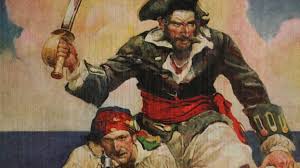
Just saying the words, "Letters of Marque" is to conjure the myth and romance of the pirate: Namely, that species of corsair also known as Blackbeard or Long John Silver, stalking the fabled Spanish Main, memorialized in glorious Technicolor by Robert Newton, hallooing the unwary with "Aye, me hearties!"
Perhaps it is no surprise that the legendary patois has been resurrected today in Congress. Sen. Mike Lee (R-Utah) has introduced the Cartel Marque and Reprisal Reauthorization Act on the Senate floor, thundering that it "will revive this historic practice to defend our shores and seize cartel assets." If enacted into law, Congress, in accordance with Article I, Section 8 of the Constitution, would license private American citizens "to employ all reasonably necessary means to seize outside the geographic boundaries of the United States and its territories the person and property of any cartel or conspirator of a cartel or cartel-linked organization."
Although still enshrined in Constitutional canon, the fact that American citizens can be empowered to make war in a wholly private capacity skirts centuries-long understanding over "the laws of war." At best, a letter of marque is to be issued only in the circumstance of a legally issued state declaration of war. Hence, a licensed corsair or privateer is akin to a sheriff's deputy, who even as a private armed person is sworn to abide by the order and laws of the state.
History, however, does not support this best case. The plain truth — again, over centuries — tells the story of private naval enterprise practically unfettered. These are no Old West deputies under direct command of a U.S. Marshal. These are licensed raiders, serving autonomously, as flag-waving freebooters.
A letter of marque, the King's signature notwithstanding, is simply licensed predation at sea — and this is under the most favorable aegis, when said letter is actually granted to a private person when the nation is at war. Yet most often, for the last 700 years, a letter of marque is really no more or less legal piracy.
But why would states want to create such a legal justification for attacking rivals and competitors, pesky inconvenient minor states, or in this case, drug traffickers?
Rep. Tim Burchett (R-Tenn), who introduced his own bill in February, proudly confesses to the Washington Post that letters of marque would give "the president some constitutional power to go after the Bad Guys and not wait on Congress to give their permission."
Here we come to our world reality — the exact same reality that has held for seven centuries — and that is this: States want to degrade their rivals, competitors, and their pesky minors without having to go to actual war. This is an ironclad rule of "international relations" that is also (forever cynically) unspoken. War continues as it has always, outside of any laws.