










Breaking News
 New Washington Legislation Makes 3D Printers Surveillance Tools
 The Ruthlessness and Brutality of the U.S. Government
 Exclusive -- Trump's 'Quiet Hammer': How CIA Director John Ratcliffe Has Revitalized...
 Rugged phone with multi-day battery life doubles as a 1080p projector
Top Tech News
 Researchers who discovered the master switch that prevents the human immune system...
 The day of the tactical laser weapon arrives
 'ELITE': The Palantir App ICE Uses to Find Neighborhoods to Raid
 Solar Just Took a Huge Leap Forward!- CallSun 215 Anti Shade Panel
 XAI Grok 4.20 and OpenAI GPT 5.2 Are Solving Significant Previously Unsolved Math Proofs
 Watch: World's fastest drone hits 408 mph to reclaim speed record
 Ukrainian robot soldier holds off Russian forces by itself in six-week battle
 NASA announces strongest evidence yet for ancient life on Mars
 Caltech has successfully demonstrated wireless energy transfer...
 The TZLA Plasma Files: The Secret Health Sovereignty Tech That Uncle Trump And The CIA Tried To Bury



What Happens When Cheap Chinese EVs Hit Canada? Look At Australia.
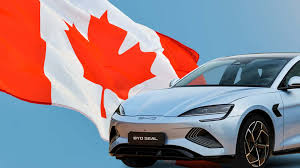
There are a lot of choices in China's car market, and nearly every one of them is desperately seeking a new home in some export market. Brands like BYD or Xiaomi may have strong sales and profitability at home, but that's the exception, not the rule. There are dozens of smaller players with big dreams and goals of seeing global domination outside of China, since, well, they just can't generate the local volume needed to hit profitability.
Often, these cars from lesser-known companies rely on exports to turn around dire profitability and sinking sales trends in their home country. Just look at Neta, a Chinese brand that has faced falling sales and financial woes in China as of late. It has hoped to find success by pivoting to markets like Thailand and Brazil. But the cars themselves don't seem like they're as good as ones from bigger brands with more money, like Geely or BYD, nor do they have the same after-sales support.
As Canada gets access to Chinese cars, I can't help but wonder: Which brands come through first? And if they all run through the door at once, which ones actually pull this off?
If you go down under to Australia, you could start to see an answer.
Chinese auto brands have made serious inroads into Australia in recent years, filling a vacuum as Ford and General Motors have given up on local production. "The market share of Chinese brands in Australia is around 17% now, versus 1.7% in 2019. This is [tenfold] growth since COVID, in other words," said Mike Costello, an analyst with Cox Automotive Australia and New Zealand.
Both countries are developed but sparsely populated, with similar colonial histories and a similar size on the global stage. Canada is the bigger country economically and by population, with the larger car market to boot. Over 1.8 million cars were sold in Canada last year, compared to 1.2 million in Australia.
Geographically and geopolitically, Australia is inherently closer to China. Chinese brands have been on the continent since at least the late 2000s, with Great Wall Motors launching in 2009, and later Chery in 2011. Chery exited Australia in 2015, partially due to poor quality and crash safety ratings, but would later re-enter in 2023 with significantly improved vehicles amid a growing desire for both affordable cars and electrified ones.
Now, that 17% does include the wide range of pure gas-powered and hybrid models sold from brands like Chery or Great Wall Motors. Yet, when we focus on EVs, it's clear that Chinese contenders have huge appeal for Australians.
A full 77% of all EVs sold in Australia in 2025 were made in China—even ones from non-Chinese brands. Costello says that 41% of Australia's EV market is held by 22 Chinese brands selling over 30 different individual models.
When it comes to plug-in hybrid models, BYD takes the lion's share with 68% of all models sold there. As a whole, Australia's EV market is about 8.6% of its total market, about the same as the U.S. But while the total American market is about 15 times larger, it has significantly fewer brands to choose from.