










Breaking News
 Ukraine is not building one drone interceptor. It's building an air-deffence ecosystem.
 Resist The Surveillance State: 100 Ways to Fight Digital ID!
 Elon Musk: True – to 'not only have conservatives become vanishingly rare in academia...'
 Trump Undecided on Moving Forward $14 Billion Arms Package for Taiwan After Talks With Xi
Top Tech News
 Sodium Ion Batteries Can Reach 100 Gigawatt Per Hour Per Year Scale in 2027
 Juiced Bikes proves capable electric motorcycles don't have to cost a lot
 Headlight projectors turn your car into a drive-in theater
 US To Develop Small Modular Nuclear Reactors For Commercial Shipping
 New York Mandates Kill Switch and Surveillance Software in Your 3D Printer ...
 Cameco Sees As Many As 20 AP1000 Nuclear Reactors On The Horizon
 His grandparents had heart disease.
At 11, Laurent Simons decided he wanted to fight aging.
His grandparents had heart disease.
At 11, Laurent Simons decided he wanted to fight aging.
 Mayo Clinic's AI Can Detect Pancreatic Cancer up to 3 Years Before Diagnosis–When Treatment...
A multi-terrain robot from China is going viral, not because of raw speed or power...
 The World's Biggest Fusion Reactor Just Hit A Milestone


Ukraine is not building one drone interceptor. It's building an air-deffence ecosystem.
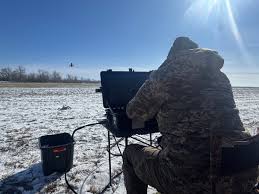
The important signal is architectural diversity. Ukraine is not betting everything on one platform, one supplier or one technical answer. It is building a layered family of small FPV-derived interceptors, fixed-wing designs, larger loitering systems, X-wing hybrids, high-speed variants, endurance-focused platforms and specialised systems for different target sets, from reconnaissance UAVs and decoys to heavy Shahed-type attack drones.
That matters because #DroneWarfare is now a cost-curve fight. A Shahed should not always require an expensive missile, and a decoy should not always consume a premium interceptor. Ukraine's answer is to build many cheaper layers that can match the threat more intelligently, preserve scarce air-defence missiles and turn industrial speed into defensive depth.
?? The autonomy debate is just as important. Hrytseniuk reportedly points to a human-on-the-loop model, where a human retains the authority to cancel or block action but does not necessarily approve every intercept in real time. That is a major shift, driven by reaction speed against mass drone attacks, but it also raises the central question every military will face: how much autonomy is acceptable when seconds decide whether a city, power plant or airbase is hit?
For #Ukraine, the lesson is brutally practical. Air defence is no longer only a question of radars, launchers and missiles; it is becoming a software-defined, mass-manufactured, continuously updated kill web where startups, soldiers, volunteers and state platforms iterate together under fire.
In #ModernWarfare, the country that can adapt the interceptor faster than the enemy adapts the drone begins to change the economics of the sky.