










Breaking News
 The War on Crypto Was Always About Control
 Open Records Laws Reveal ALPRs' Sprawling Surveillance...
 The Pandemic Agreement Fails Again
 10 Things You Should Know About Homeschool Moms
Top Tech News
 Cars Are Fast Becoming Dystopian Prison Pods...
 Our Emergency Water Plan Wasn't Good Enough - So We Built This
 Sodium Ion Batteries Can Reach 100 Gigawatt Per Hour Per Year Scale in 2027
 Juiced Bikes proves capable electric motorcycles don't have to cost a lot
 Headlight projectors turn your car into a drive-in theater
 US To Develop Small Modular Nuclear Reactors For Commercial Shipping
 New York Mandates Kill Switch and Surveillance Software in Your 3D Printer ...
 Cameco Sees As Many As 20 AP1000 Nuclear Reactors On The Horizon
 His grandparents had heart disease.
At 11, Laurent Simons decided he wanted to fight aging.
His grandparents had heart disease.
At 11, Laurent Simons decided he wanted to fight aging.
 Mayo Clinic's AI Can Detect Pancreatic Cancer up to 3 Years Before Diagnosis–When Treatment...



Trump administration backs nuclear fusion -- as a company tied to Trump invests in it
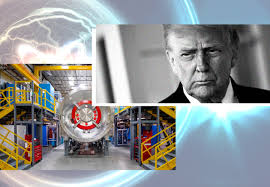
In October, the Trump administration released a "Fusion Science and Technology Roadmap" to support the construction of commercial fusion power plants as soon as the 2030s. It may not exactly resemble a Manhattan Project for nuclear fusion, but the road map indicated the federal government would support a constellation of American fusion companies and no longer treat them like an academic project.
Among several approaches, the road map pointed to a unique reactor concept — field-reversed configurations, "which could significantly reduce the cost of fusion power." It also referenced aneutronic fuels as being a potential source of "perhaps the greatest cost savings."
Two months later, in December, Trump Media & Technology Group
— the publicly traded company behind President Donald Trump's Truth Social online platform — announced a merger agreement with TAE Technologies, an American fusion company that has helped pioneer field-reserved configurations and been a leader in the commercial development of aneutronic fuels.
The deal, which has not yet closed, represented an abrupt change of course for TMTG. Its stock soared two years ago as it became a popular way to bet on Trump's 2024 election win, but it has seen its shares drop by around 80% since that victory. The Florida-based company's moves to diversify by holding bitcoin
and launching exchange-traded funds haven't come close to lifting its stock back to its prior heights.
Now, TMTG is pivoting toward nuclear fusion, a corner of the energy industry that has the Trump administration's support as it aims to start providing actual commercial power to the country's grid in a matter of years, after decades of experimentation. Nuclear fusion, which joins atoms, is the reaction that powers the sun; the technology remains unproven. Existing U.S. nuclear plants, which provide an estimated 18% of the country's electricity, rely on fission, which splits atoms.
But the Trump administration and its Energy Department are giving fusion a push from the federal government. Trump has issued executive orders to support the fusion industry and, in addition to providing its fusion road map, the Trump administration in November established an elevated Office of Fusion. The Nuclear Regulatory Commission, an independent federal agency, is in the process of finalizing a new regulatory framework for the fusion industry that some experts describe as a "light-touch" approach.