










Breaking News
 Melat Kiros Stuns Colorado, Defeats 15-Term Incumbent Diana DeGette
 'United Saints of America': Trump-Inspired 'Fighter' Singer Jon Kahn, Nashville Hit-
 Palestinians Report Intensified Israeli Military Operations in the Gaza Strip
 Qatar Says US Officials in Doha Will Not Hold Direct Talks With Iranians
Top Tech News
 World's first hotel entirely staffed by robots to open in 2027
 Researchers in China are ignoring bug spray, citronella, and netting.
 Our bodies may be able to regrow lost limbs after all
 Chinese cars go blacker than black via hybrid nano tech
 World first: Human embryo model grows its own organs – in the lab
 Dead lithium batteries revived to 95% capacity via electrochemical bath
 Compact laser engraver levels up your DIY crafts setup
 'Groundbreaking' Potential Lupus Cure Sends Patients into Remission, Allowing Dreams...
 Speculations on What Could Show Physics Beyond the Standard Model
 SpaceX Orbital Travel and Orbital Hotels Need Starfall – Getting Back Safe and Cheap is Exciting



Congress Blocks Amendment To Stop Integration of U.S. And Israeli Militaries
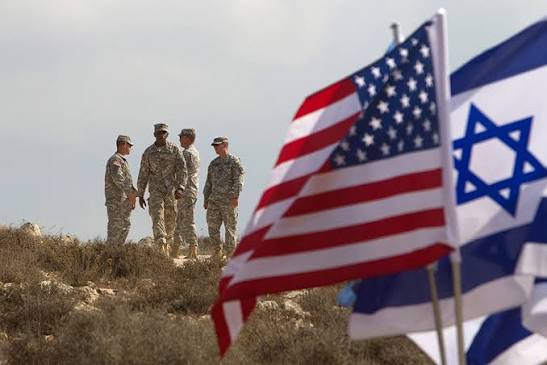
The abrupt change of posture led by Vice President J.D. Vance has left Americans questioning whether or not that new position signals a paradigm shift in U.S. foreign policy or if it is nothing more than empty rhetoric aimed at appeasing the masses who have become increasingly disenfranchised by the administration over its virtually unconditional support for the Jewish state. A decision from Congress blocking a bipartisan amendment introduced by representatives Thomas Massie and Ro Khanna that would have removed the controversial provision from the National Defense Authorization Act ("NDAA") integrating the U.S. and Israeli militaries answered that lingering question by showing that unfettered support for Israel remains business as usual in Washington, D.C., despite any empty political posturing to the contrary.
The amendment introduced by Massie and Khanna sought to remove Section 219 (formerly Section 224) from this year's NDAA. That provision is poised to establish a United States-Israel Defense Technology Cooperation Initiative which expands cooperation between the two nations in a manner that opponents have raised criticisms about over how it effectively integrates their two militaries. In the wake of public support in the U.S. declining to record lows, the revelation of Section 219 has been met with vitriol from U.S. taxpayers who have come to view Israel as a pariah on the world stage, a stark departure from the long-standing sentiment inculcated into the American public that the country serves as its greatest ally. Representatives Massie and Khanna harnessed that shifting sentiment by drafting an amendment to the NDAA that would have removed Section 219 from the text of the proposed legislation, only to have their effort blocked by the House Rules Committee after it chose to exclude it from a list of amendments made in order. In doing so, the committee ensured the amendment would not receive any debate or a recorded vote on the House floor.
In addition to excluding the amendment put forward by Massie and Khanna, the House Rules Committee also excluded another introduced by Democratic representative Alexandria Ocasio-Cortez that sought to rein in U.S. arms sales to Israel. The amendment introduced by Ocasio-Cortez would have imposed conditions for offensive and defensive military aid to Israel. Those conditions would have required U.S. foreign military aid to comply with international law by banning the transfer of weapons to countries blocking U.S. or United Nations' humanitarian aid to civilians.
The House Rules Committee utilized this mechanism to preserve Section 219 of the NDAA in the face of widespread bipartisan condemnation of the provision. When announcing his intent to offer an amendment striking the provision from the NDAA, Massie highlighted how its passage would further undermine U.S. sovereignty. Massie's position was echoed across the aisle by Khanna, who ultimately introduced the amendment, which was co-sponsored by other Democratic representatives Jim McGovern, Jesús G. García, and Rashida Tlaib. Their bipartisan effort, though blocked, reflected the popular will of the American people who reached out to lawmakers from both parties to compel them to remove Section 219 from the NDAA after the once-obscure provision fell into the spotlight over the discourse surrounding the proposed legislation. When discussing the provision, Massie succinctly summarized that position felt by U.S. citizens, stating, "If Section 219 is signed into law, the American people should see it as Congress fully capitulating our nation's autonomy to foreign influence."