










Breaking News
 OccupyTheLand WORKshop.
 Could YOU survive the apocalypse? Experts reveal the skills you'll need when the world falls...
 Ilhan Omar torches Trump over 'political intimidation' after feds raid home amid immigration
 ATF Drops Registration For Suppressors And Short-Barreled Rifles Nationwide After DOJ Declines...
Top Tech News
 Anduril's plan to save US sub edge from China's undersea surge
 Researchers Develop AI 'Mind-Reading' Tool That Reconstructs What Your Eyes See
 Video: Dexterous robot hand learns the delicate art of silk embroidery
 The computer that can read your mind:
 Seven apps. One craft
 SHOCK CASE REPORT: Advanced Alzheimer's Patient Regains Speech, Memory, Mobility...
 Most artificial limbs rely on silicone or plastic to mimic human hands.
 Flying cell tower beams phone signal to Japan from 10 miles up
 Chinese Commercial Reactor Achieves Nuclear Fusion with Clean Hydrogen-Boron Fuel
 Palmer Luckey: Autonomous Weapons Are Ancient and Why Anduril Won't Build Humanoids | EP #295



Putin's scorched-city policy hits Ukraine hard
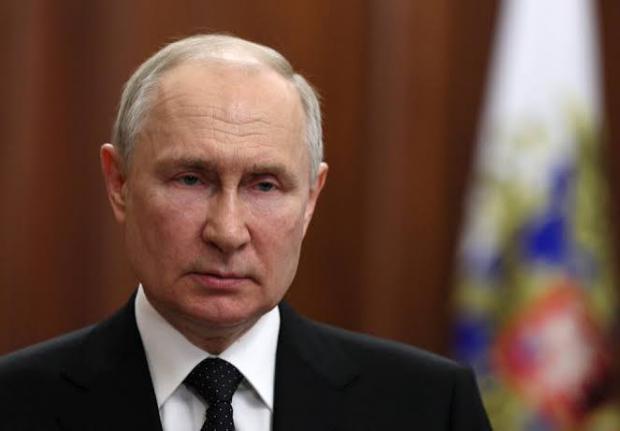
During a quarter-century in power, Vladimir Putin has led Russia into three wars, in part aimed at restoring his country's status as a world power via violent conquest .
Each war began in a blitzkrieg-style display of fearsome power meant to climax in a swift victory.
Instead, each conflict, whether the 1999-2009 war on the Russian province of Chechnya, or the 2015-2024 air campaign in Syria to help dictator Bashar al-Assad fight Islamic rebels or now the Ukraine war, descended into a single strategy: bludgeoning use of air power against cities in tactics reminiscent of World War II.
Because Grozny, the Chechen capital, was the first victim of such battering, military experts have dubbed the strategy the "Grozny Model" or, sarcastically, "Peace Through Obliteration."
"I hate to use this term, but I think the 'Grozny-fication' of Kyiv has begun," Max Hess, a fellow at the Foreign Policy Research Institute, told an American television interviewer. "And that is something I thought was unimaginable."
The latest chapter began last Tuesday, when Russian sent scores of drones and ballistic missiles to bombard civilian neighborhoods in Kyiv, the Ukrainian capital, and killed 21 residents, including some children. The next three days saw bombardments of least three other cities. More than 100 people. died Emergency workers in the south-central town of Pryluky dug up 22 bodies from the ruins of an apartment building, Ukrainian television showed.
On Saturday, glide-bombers, which are winged projectiles launched from aircraft, killed 15 civilians in Zaporizhia, site of a nuclear power plant. "Its counter-city campaign may aim to drive out remaining civilians and collapse the capacity and will of Ukrainian defenders to resist any military occupation," predicted Colin P. Clarke, a researcher at The Soufan Center, a security analysis and research center based in New York.
James Hughs, a professor at the London School of Economics and Political Science, offers a similar assessment and a pessimistic prediction: "What has occurred in Ukraine so far, tactically, is an iteration of Russia's Chechen conflict but on an even more immense scale. The strategic outcome, however, is likely to be similar – a costly Russian victory at the expense of massive opposition losses, destroyed infrastructure and depopulation."
Putin's goals are largely consistent, but tactics have evolved since the Chechen war.
I covered the assault on Grozny in late 1999 and into 2000. Russian jet bombers freely roamed the skies and tanks and artillery pummeled the city.