










Breaking News
 The Precious Metals Crisis That Could Trigger A Global Financial Reckoning
 Qatar's Government Revenue Plunges 42% In First Half As Iran War Knocks Out Gas Exports
 Chinese Researchers Unveil Plans For Tank That Can Remain Submerged For Two Hours
 Everything Is Russia's Fault (Even Global Warming!)
Top Tech News
 I Built a Website to Expose Solar and Battery Scams
 Whistleblower Issues Dire Warning: Rogue AI, Hacking Nuclear Programs...
 Multi-material insulation delivers up to 10,000 x the stiffness
 Anduril's plan to save US sub edge from China's undersea surge
 Researchers Develop AI 'Mind-Reading' Tool That Reconstructs What Your Eyes See
 Video: Dexterous robot hand learns the delicate art of silk embroidery
 The computer that can read your mind:
 Seven apps. One craft
 SHOCK CASE REPORT: Advanced Alzheimer's Patient Regains Speech, Memory, Mobility...
 Most artificial limbs rely on silicone or plastic to mimic human hands.



Chinese Researchers Unveil Plans For Tank That Can Remain Submerged For Two Hours
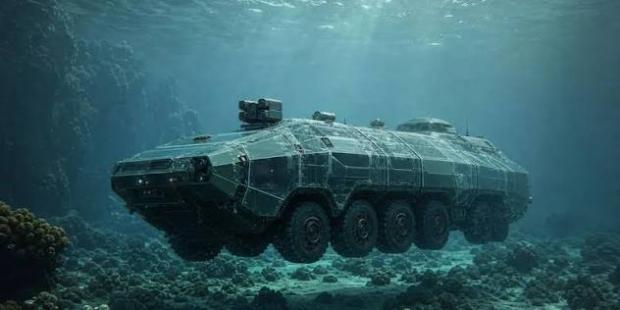
The proposed system would allow an armored vehicle to travel at depths of up to 164 feet before emerging from the water and continuing its mission on land. The idea is to give military forces greater flexibility during coastal assaults while reducing their reliance on traditional landing equipment.
SCMP writes that the project, developed by researchers at the Inner Mongolia First Machinery Group and Beijing Institute of Technology, is part of a larger effort to create military vehicles capable of rapidly adapting to different battlefield conditions.
Rather than designing separate vehicles for every environment, researchers are experimenting with interchangeable modules that could allow a single platform to perform multiple roles. The proposed vehicles would also incorporate drones to help clear obstacles and potentially accelerate amphibious landings.
On land, the hybrid-powered platform is envisioned as having a range of roughly 373 miles and reaching speeds of more than 43 mph. Researchers are also targeting a nine-second response time between identifying a threat and launching an attack.
Initial testing has demonstrated promising results for the vehicle's modular components, but the underwater capabilities have not yet been proven. The researchers have not disclosed how fast the vehicle could travel underwater or how far it could move while submerged.
The concept is part of China's longer-term military technology planning for the period between 2030 and 2050, as researchers explore how armored vehicles might operate across multiple combat environments.