










Breaking News
 Another Mass Shooter Stopped By Armed Citizen In Oregon
 Negative Political Ads: Voters Despise Them, But Campaigns Keep Using Them
 The Future Of American Drone Warfare
 The Precious Metals Crisis That Could Trigger A Global Financial Reckoning
Top Tech News
 I Built a Website to Expose Solar and Battery Scams
 Whistleblower Issues Dire Warning: Rogue AI, Hacking Nuclear Programs...
 Multi-material insulation delivers up to 10,000 x the stiffness
 Anduril's plan to save US sub edge from China's undersea surge
 Researchers Develop AI 'Mind-Reading' Tool That Reconstructs What Your Eyes See
 Video: Dexterous robot hand learns the delicate art of silk embroidery
 The computer that can read your mind:
 Seven apps. One craft
 SHOCK CASE REPORT: Advanced Alzheimer's Patient Regains Speech, Memory, Mobility...
 Most artificial limbs rely on silicone or plastic to mimic human hands.



The Future Of American Drone Warfare
Whether this is the next stage in escalation, or the grand finale remains unclear. But lessons continue to emerge from this conflict, and world powers are beginning to act on them at scale.
Ukrainian long-range drones continue to hammer Russian energy and military sites. Targets up to 1,700 kilometers inside Russia are being hit.
These strikes are causing serious economic damage to Russia, not to mention the environmental harm. Here's a screenshot of recent fires at Russia's Rosneft facility on the Black Sea after Ukrainian drone attacks.
Earlier this week, President Trump expressed his anger at Ukrainian President Zelensky, "It's time for Ukraine to get a NEW PRESIDENT!"
Ukraine's strikes are hammering Russia's fuel production, and causing shortages worldwide.
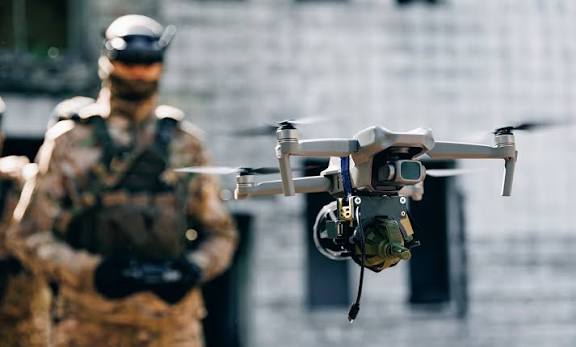
On the front lines, short-range drones are now Ukraine's primary weapon holding back Russian advances. Most of these are small drones with anti-tank RPG warheads attached.
Crude, but highly effective. There are also bomber drones which drop grenades, mortars, and improvised munitions. Interceptor drones roam the skies, looking to foil enemy attacks.
Both sides are using flamethrower drones, which drip molten thermite to melt anti-drone netting and ignite enemy structures.
Meanwhile Russian long-range drones and missiles are increasingly hitting military sites in the capital, Kiev (Kyiv). And across the rest of the country. Glide bombs are devastating the front lines. And Russia is using at least as many short-range drones as Ukraine is.
It is estimated that up to 15,000 drones are being used in Ukraine per day. And that up to 90% of casualties are caused by these terrible little machines.
Traditional maneuver warfare is extremely difficult in these conditions. Advances crawl forward at a snail's pace.
Tanks and IFVs are increasingly irrelevant on the battlefield. Even artillery, the "God of War", has become an afterthought.
In just a few short years, this new class of drones have changed warfare forever. The question is: are American defense contractors ready for this new world?
Petraeus' Warning
Former Army General and CIA Director David Petraeus is out with a new warning about drone warfare. I'm not a fan of the man, but what he says here is true.
"We have not remotely learned all the lessons we should have from the war in Ukraine.
That is the future of war right now. Ukraine is using 10,000 drones a day.
Ninety percent of the casualties on the Russian side are caused by drones. Tanks can't manoeuvre anymore. They can't survive. Armored vehicles can't survive.
And by the way, there's more coming. Within a year or two, we're going to see unmanned systems that are not remotely piloted.
In the future, we're going to see autonomous systems - truly autonomous - that do not require a pilot to remotely operate them.
Then you face drone swarms. And that is something for which we really don't have a solution."