










Breaking News
France's Immigration Party Coming to America: Faster Than You Think
A3Podcast 8 - Our Enemy, the State; Publishing and Accessing An IPFS Website; and more...
 Tuesday War Room LIVE – 'Let Us In': 1 Million Migrants Torch Italy As Trump Warns...
 The Fall of Saudi Arabia?
Top Tech News
 Solar Panels Are Doing Something Nobody Expected
 DeLorean climbs skyward to race electric flying cars
 Atari's 800XL returns with a keyboard, cartridges and BASIC
 Bioinspired robot airdrops into remote waters via morphing wing-sail
 Anduril interceptor adapts to emerging threats via swappable stages
 I Built a Website to Expose Solar and Battery Scams
 Whistleblower Issues Dire Warning: Rogue AI, Hacking Nuclear Programs...
 Multi-material insulation delivers up to 10,000 x the stiffness
 Anduril's plan to save US sub edge from China's undersea surge
 Researchers Develop AI 'Mind-Reading' Tool That Reconstructs What Your Eyes See



The Fall of Saudi Arabia?
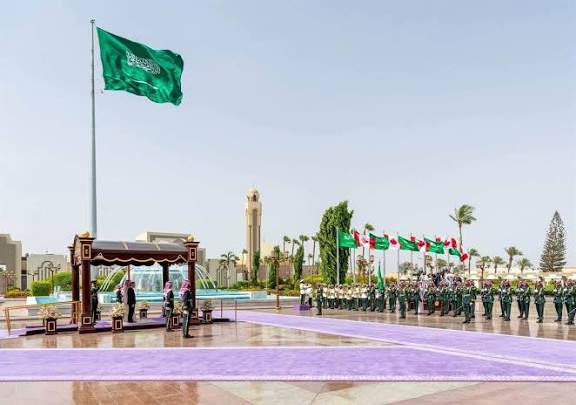
That crucial economic role and the vast gusher of wealth thus generated had established KSA as one of the most important countries in the world.
The Middle East is a dangerous neighborhood, and the Saudis had long recognized that fact. In recent years, their annual defense budget had been the eighth largest on earth, far ahead of what was spent by France or Japan and approaching that of India.
Over the last dozen years their military expenditures totaled around a trillion dollars, and much of that had been invested in some of America's most advanced and expensive weapons systems. The Saudis deployed hundreds of advanced combat aircraft, so that on paper they possessed nearly twice the striking power of Israel's very formidable air force.
They had also taken many other steps to ensure their safety.
America had long regarded them as our most important Arab ally, and we had provided security guarantees stretching back to President Franklin Roosevelt's famous meeting with King Ibn Saud in 1945. The Saudis hosted some of our own local military forces, and their country was ringed by several of our largest regional bases in Bahrain, Qatar, Kuwait, and the UAE.
Although the Saudis were seen as close American allies, they also maintained excellent relations with Russia, with which they shared leadership of OPEC+, and with China, the top buyer of their oil.
The Saudis also carefully cultivated friends and influenced people by spreading portions of their vast wealth across the Muslim world and beyond. Egypt's huge and impoverished population was partially dependent upon such Saudi largess, while the government of nuclear-armed Pakistan was in a similar situation.
This towering international role for the Kingdom contrasted very sharply with the status of Yemen, their obscure neighbor situated at the bottom of the same Arabian peninsula. That latter country fell at the exact opposite end of the global spectrum, barely known for anything other than khat, the mildly stimulative drug that its impoverished population constantly chewed, often injuring their gum tissue as a consequence.
Political division and civil war had long been endemic to Yemen. For more than twenty years the internationally recognized government of that country has been locked in a bitter conflict with the rebellious Houthis, a northern militia of fierce mountain tribesmen who gave it a great deal of trouble despite its strong military support from both the Saudis and the UAE.
I doubt that too many people around the world had ever paid much attention over the years to the khat-chewing Houthis or their simmering resentment at what they regarded as Saudi interference in their own country's internal political conflict.
But in recent weeks and especially in recent days, this situation has been drastically transformed. Our news headlines have been filled with reports of the terrible destruction that Houthi missiles and Houthi drones have inflicted upon Saudi Arabia, a country with a per capita GDP that was roughly one hundred times higher.