










Breaking News
 Little Marco Makes a Big Mess in Iran
 Ravens Bench Star Cornerback Marlon Humphrey After He Jokes Baltimore Is...
 Trump's Strategic Blunder in Calling Putin and Xi "My Friends"
 Aptera builds first production solar car that adds up to 40 miles daily from sunlight
Top Tech News
 Extraterrestrial habitats may rise via Legos of laser-fused moon dust
 Battery-only 19-seater puts China in the electric airliner race
 Dream Chaser space plane gets landing approval for debut mission in 2027
 SpaceX Just Caught Starship on Its FIRST Attempt!
 Solid-State Cells Can Make The U.S. Competitive In Batteries Again: CEO
 Jetson ONE personal eVTOL pod is about to go full sky patrol
 America's INSANE BREAKTHROUGH Could Replace Septic Tanks Forever
 Amazing DIY Building Material for Home & Yard - Inexpensive and Easy!
 Researchers have discovered a massive deposit of hidden water...
 Amazon's Ring Unveils Flying Drone And Robot To Patrol Homes And Businesses



Aptera builds first production solar car that adds up to 40 miles daily from sunlight
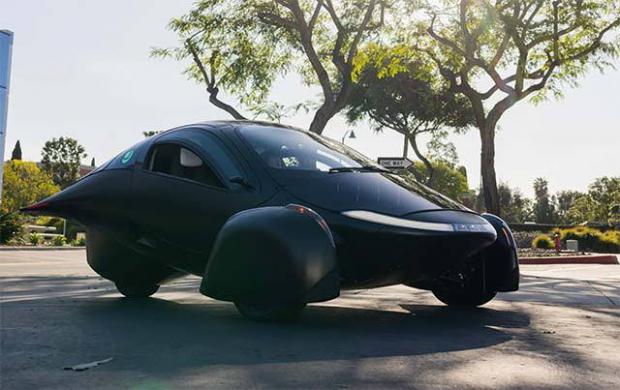
A buyer outside the United States will soon receive the first production solar electric vehicle built for sale by Aptera Motors. The California-based mobility company has finished assembling the three-wheeled car and is preparing to export the vehicle.
The buyer is Martin Hartono, chief executive of GDP Venture. Hartono secured the first production slot—designated as Accelerator #1—through Aptera's early investment program, which ranks customer delivery positions by the size of their financial contributions. For his inaugural model, Hartono chose a matte black exterior finish named Noir.
Aptera's engineering team designed the vehicle to harvest a significant portion of its daily energy directly from sunlight, setting it apart from conventional battery-powered cars. Solar cells embedded directly into the bodywork harvest energy throughout the day.
Under favorable weather conditions, that solar intake can generate roughly 40 miles of driving range without needing a grid connection. Drivers can still plug the vehicle into standard wall outlets or public chargers whenever additional power is required.
Independent solar testing with efficiency benchmarks
Independent testing conducted earlier in 2026 confirmed those solar charging projections. In August 2026, Aptera released performance data verified by TÜV Rheinland, an international technical inspection organization.
A month prior, in July, TÜV Rheinland solar specialist Dr. Giorgio Bardizza spent three consecutive days evaluating the vehicle at Aptera's final assembly plant in Carlsbad. Using his own calibrated instruments, Dr. Bardizza tracked solar energy collection from sunrise to sunset across three distinct daily scenarios requested by Aptera.
Rather than measuring raw electricity generated at the surface of the panels, his equipment recorded the net usable energy flowing into the battery pack after power conversion losses.
To translate that solar energy into its 40-mile daily range target, Aptera uses a projected vehicle efficiency of 100 watt-hours per mile. That efficiency standard requires the solar array to deliver at least 4.0 kilowatt-hours (kWh) of usable energy into the battery within a single calendar day. Across all three days of July testing, the vehicle surpassed that 4.0 kWh threshold.