










Breaking News
 Inflation Is Rising, but What Can the Fed Actually Do?
 From Operation Ajax to Epic Fury: Why Washington Keeps Getting Iran Wrong
 U.S. Hawks Seek To Escalate Across Multiple Fronts
 Near Certainty Vera Rubin Found a Pluto Like Dwarf Planet
Top Tech News
 Meet the Frankenhamster: Scientists create bizarre 'planimal' by fusing together hamster and
 Roof-mounted solar panels turn your EV into its own charging station
 Russia 'is preparing to launch nuclear-armed space weapon by the end of this year'...
 Underground empire: China's plan to weaponize infrastructure gear
 $21,500 pickup plans to fix the American truck problem
 Seven Down, Three To Go: America's Microreactors Keep Going Critical
 Smart Dust
 Artificial Intelligence Could Transform Bank Runs From Hours-Long Crises...
 We Can't Put AI Back in the Box… So We Must Make It Serve Pro-Human Interests
 Dubai Just Finished the World's First Permanent Air Taxi Route: Airport to the Marina in Under 1



Near Certainty Vera Rubin Found a Pluto Like Dwarf Planet
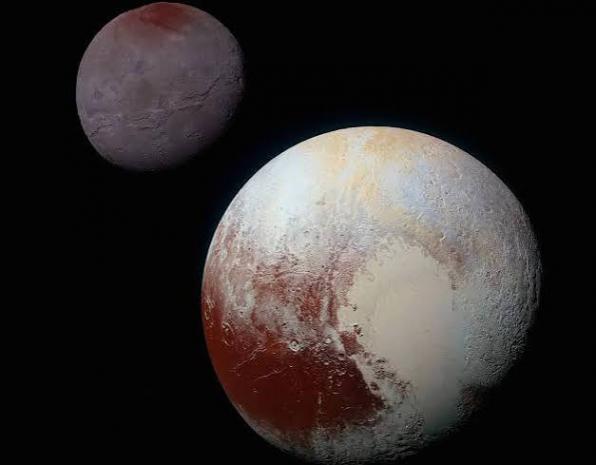
If confirmed, ED138 would be among the largest dwarf planets ever discovered in this region of the Solar System.
The orbits of the five dwarf planets recognized by the International Astronomical Union (IAU): Pluto, Ceres, Eris, Haumea, and Makemake are in the image above.
ED138 is currently at a distance of about 46 astronomical units (au), where 1 au is the average distance between the Earth and the Sun. For reference, dwarf planet Pluto has an average distance of 40 au. This classifies ED138 as a trans-Neptunian object (TNO) — objects that orbit the Sun at a distance greater than Neptune's.
ED138's orbit is tilted almost 25 degrees off of the plane of the Solar System, classifying it as a hot-classical TNO and suggesting that it was disturbed from its original orbit through gravitational interactions with Neptune.
Not all TNOs are considered dwarf planet candidates, with the distinction being in the size and shape of the object. To be a dwarf planet an object needs to be massive enough for its own gravity to pull it into a round shape. Based on ED138's distance, brightness and estimated surface reflectivity (albedo), the team estimates that its size is between 600 and 1500 kilometers, and icy bodies this large are expected to be round.
As of Sun Nov 22 2026 there are:
10 objects which are nearly certainly dwarf planets
19 objects which are highly likely to be dwarf planets
24 objects which are likely to be dwarf planets
74 objects which are probably dwarf planets
1306 objects which are possibly dwarf planets
The new object 2026 ED138
2026 ED138 was identified in early Vera C. Rubin Observatory data by Matthew Holman in October 2026 (announced 27 October). Precovery observations stretch back to a 1937 photographic plate; the object was missed for decades mainly because it lies far south and near the crowded Galactic plane.?Wikipedia
Key facts:
Absolute magnitude HV≈3.19HV?≈3.19 (one of the ten intrinsically brightest known TNOs; the brightest found since Chiminigagua in 2013).
Estimated diameter roughly 600–1,500 km depending on albedo (about 612 km at pV=0.25pV?=0.25, ~970 km at 0.10, ~1,530 km at 0.04). Discoverers consider the 600–1,000 km range more probable.
Orbit: classical (hot) Kuiper-belt object with a≈43a≈43 AU, e≈0.14e≈0.14, i≈24.5?i≈24.5?, period ~282 years. Currently ~46–47 AU from the Sun.
Color is redder than the Haumea family, so it is not a family member.