










Breaking News
 Budweiser Super Bowl 2026 Pre-Release, 'American Icons' Song by Lynyrd Skynyrd
 Tim Walz SURRENDERS to Trump After "SIGNAL GATE" Leaks!
 De-Dollarization? Gold Over Debt - The End Of The Keynesian Paper Promise Mirage
 Schiff vs. CZ: Tokenized Gold Beats Bitcoin
Top Tech News
 Researchers who discovered the master switch that prevents the human immune system...
 The day of the tactical laser weapon arrives
 'ELITE': The Palantir App ICE Uses to Find Neighborhoods to Raid
 Solar Just Took a Huge Leap Forward!- CallSun 215 Anti Shade Panel
 XAI Grok 4.20 and OpenAI GPT 5.2 Are Solving Significant Previously Unsolved Math Proofs
 Watch: World's fastest drone hits 408 mph to reclaim speed record
 Ukrainian robot soldier holds off Russian forces by itself in six-week battle
 NASA announces strongest evidence yet for ancient life on Mars
 Caltech has successfully demonstrated wireless energy transfer...
 The TZLA Plasma Files: The Secret Health Sovereignty Tech That Uncle Trump And The CIA Tried To Bury



Schiff vs. CZ: Tokenized Gold Beats Bitcoin
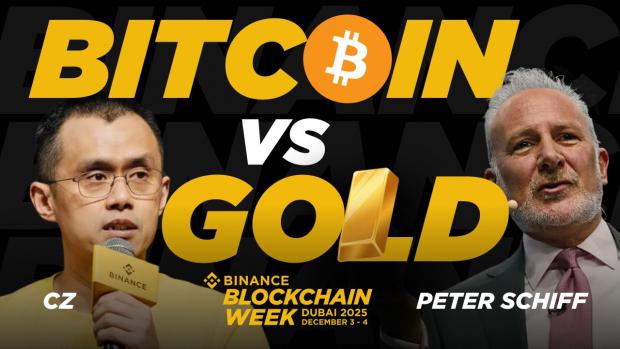
Peter recently debated Binance founder Changpeng Zhao ("CZ") in Dubai at the Binance Blockchain Week. In their dialogue, Peter goes through the case for tokenized gold and lays out why a gold-backed token can actually improve gold's usefulness as money without sacrificing its long-term value. He contrasts tokenized gold with Bitcoin and other crypto mania—calling out the hype, the ETFs, and celebrity promotion—and predicts that a rising gold market will expose Bitcoin's weaknesses.
He starts by explaining how a token can turn physical gold into an everyday medium of exchange while preserving the metal's core monetary function:
And now you can use your token as a medium of exchange. And so now you have a viable monetary unit that is a store of value because it's backed by the gold that's in the vault that anybody can take delivery of. But in the meantime, you've taken gold and you've now made it more transportable, more divisible, more fungible. You've improved on all of its monetary properties. But you don't lose the most important property, which is its store of value because its value is the gold that the token represents.
He points out that tokenization is nothing new in principle—paper receipts and IOUs once stood for stored metal—and that the token only changes the form until someone actually needs the metal for industrial or craft use:
Obviously, if you want to actually do something with the gold, if you're a jeweler, you have to take the token and redeem it. If you're manufacturing computer chips and you need gold, you have to redeem the token. But as far as using it as money, yes, it improves on gold, just like the old blacksmiths. Originally, when people had gold and they would have it stored in the blacksmith, the blacksmith would write out an IOU, a piece of paper, which could then circulate in place of gold because it was more convenient.
Peter reminds listeners why gold holds an unmatched claim on value across time: its scarcity, durability, and long history of use mean that owning gold is owning a durable claim that outlasts perishable commodities:
When I own gold, I don't just own what I can do with it today, but I own what somebody else can do with it in a thousand years, in 10,000 years, because gold doesn't go away. I mean, the gold that was mined 10,000 years ago, it's still here. I mean, you know, it doesn't go anywhere, and it's no different than it was in the past. And so gold's price today represents the present value of all of the uses from now until the end of time. You don't have that with other commodities that have a shelf life, that decay. They rot.
That permanence, he says, is the essential difference between a token backed by metal and a purely digital claim. A Bitcoin transfer, in his view, moves data; a tokenized gold transfer moves ownership of an underlying real asset:
But at the end of the day, when I transfer my Bitcoin to you, I've transferred nothing. I have nothing. I give you nothing. When I transfer tokenized gold to you, I've transferred gold. I've transferred the ownership of the gold, and what gives the gold the value is what you do with it as a metal.