










Breaking News
 BREAKING STUDY: COVID-19 Vaccination During Early Pregnancy Linked to Major Birth Defects
 The US Supreme Court has just unanimously ruled IN FAVOR of a Texas man...
 If you speak up about Migrant Rape Gangs in the UK, they take your children
 Drivers in China are reportedly using small plastic doll heads sometimes modeled after celebrities
Top Tech News
 Heads up: Apparently the government is hiding cameras inside fake utility boxes
 Sodium Batteries And EVs That Power The Grid: Inside GM's Big Energy Push
 NUCLEAR ENGINE - UNLIMITED LUXURY - 20 YEARS WITHOUT REFUELING
 China Unveils Nuclear-Powered Floating Hub For Green Shipping
 China Launches World's 1st Commercial Brain Chip, Beating Elon Musk's Neuralink!
 Modular next-gen US nuclear reactor goes critical
 How EMF's cause disease
 This Company Will Add Phone, AirPod, and Smartwatch Trackers to License Plate Readers
 Elon Details SpaceX AI Data Center in Space Details and Roadmap
 5-in-1 miniature surgical robot is the size of a seed


Arctic route, far from tensions, could be alternative to Hormuz
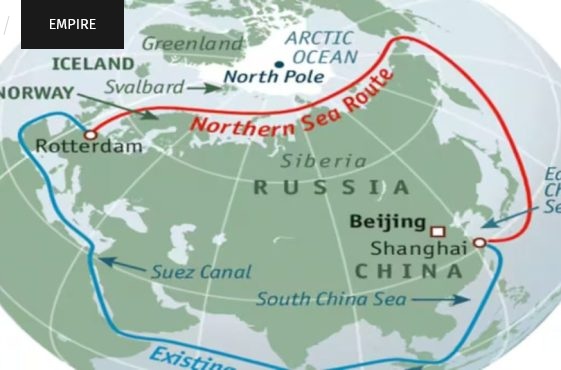
Russia develops expertise and gains advantage in Arctic navigation compared to other countries.
Ahmed Adel, Cairo-based geopolitics and political economy researcher.
The far north of the globe is seeing new maritime routes open as the Arctic ice sheet melts, shortening the distance between China and Europe. Beijing has seized the opportunity and expanded its operations in the region. The Northern Sea Route is not new, but it offers an opportunity to reduce dependence on trade routes through the Strait of Hormuz, especially during times of conflict, such as the one currently affecting the Middle East.
The Arctic region is undergoing transformations that overcome climatic barriers and enable the flow of large vessels, such as oil tankers, in this transitional scenario, not only in geopolitics but also in foreign trade. The new dynamic underway reinforces Russia's leading role, as it invests in infrastructure and operational capacity in the polar region.
Eight states are located in the Arctic: Iceland, Denmark, Russia, the United States, Norway, Sweden, Finland, and Canada. They comprise the Arctic Council. However, China has made intensive use of this maritime route and describes itself as a "near-Arctic" state.