










Breaking News
 Watch: Globalist Alex Soros Catches Major Backlash After Unbelievable 'Freudian Slip' Expose
 The Spirit of Liberty in 1776 versus Today's Political Paternalism
 Incredible portable survival pod fends off bombings, floods and worse
 Your brain doesn't peak in your 20s after all: Study reveals your mind is at its sharpest betwee
Top Tech News
 Our Diesel-Electric Truck Is So Quiet the Military Wants One
 World's first hotel entirely staffed by robots to open in 2027
 Researchers in China are ignoring bug spray, citronella, and netting.
 Our bodies may be able to regrow lost limbs after all
 Chinese cars go blacker than black via hybrid nano tech
 World first: Human embryo model grows its own organs – in the lab
 Dead lithium batteries revived to 95% capacity via electrochemical bath
 Compact laser engraver levels up your DIY crafts setup
 'Groundbreaking' Potential Lupus Cure Sends Patients into Remission, Allowing Dreams...
 SpaceX Orbital Travel and Orbital Hotels Need Starfall – Getting Back Safe and Cheap is Exciting



The Spirit of Liberty in 1776 versus Today's Political Paternalism
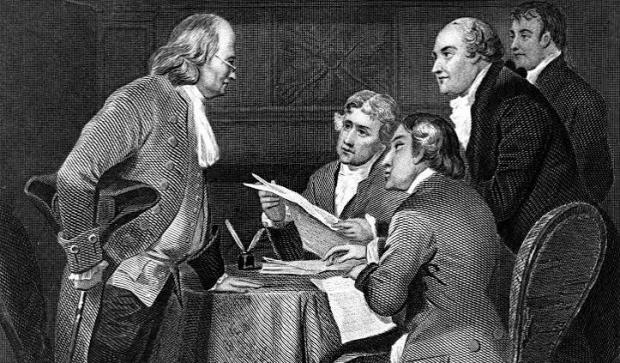
Almost every American, from their very first school days, knows more or less by heart those stirring words penned by Thomas Jefferson in enunciating the fundamental principles and premises upon which the 13 North American colonies of the British Empire announced their reasons for politically breaking from the Mother Country:
We hold these truths to be self-evident, that all men are created equal, that they are endowed by their Creator with certain unalienable Rights, that among these are Life, Liberty and the pursuit of Happiness. That to secure these rights, Governments are institute among Men, deriving their just powers from the consent of the governed — That whenever any Form of Government becomes destructive of these ends, it is the Right of the People to alter or to abolish it, and to institute new Government, laying its foundation on such principles and organizing its powers in such a form, as to them shall seem most likely to affect their Safety and Happiness.
The Declaration's authors go on to say that taking up arms against the established government was no thoughtless decision. Only after many attempts for peaceful redress of their complaints and grievances against the policies and actions of the government should a people take on such a momentous step. But when there has occurred "a long train of abuses and usurpations … it is their duty, to throw off such Government, and to provide new guards for their future security."
The grievances against the British Crown
What is less emphasized in most references to and praise of the Declaration are the enumerated grievances that led to the call for independence from Great Britain. As Jefferson expressed it in the Declaration, "The history of the present King of Great Britain is a history of repeated injuries and usurpations, all having in direct object the establishment of an absolute Tyranny over these States." Strong words, indeed. So what was the king and government of Great Britain doing to the people of the American colonies to justify such drastic action as rebellion and revolution?
King George III's government had weakened or taken away local government representation and put in its place governors appointed by the monarch's government in London. He attempted to wear down local political opposition, thereby weakening or ending American forms of home rule. The king was, "Abolishing the free System of English laws … taking away our Charters, abolishing our most valuable Laws, and altering fundamentally the Forms of our Governments … Suspending our own Legislatures, and declaring themselves invested with power to legislate for us in all cases whatsoever."
The British government had interfered with and in fact attempted to prohibit the free migration of people into and between the 13 colonies: "He has endeavored to prevent the population of these States; for that purpose obstructing the Laws of Naturalization of Foreigners; refusing to pass others to encourage their migration hither, and raising appropriations of Lands." The British government attempted to both restrict the numbers of and locations into which settlers and migrants could enter and move between one area to another within the 13 colonies, and beyond.