










Breaking News
 The Stock Market Is Ignoring A Five Alarm Fire
 Are Houthis making Pakistan nervous? Mecca pact tested as Saudis get hammered
 Florida Sues Pfizer, Accusing It of Covid Vaccine Deception and Profiteering
 The State as an Extension of Self: Psychological Evil
Top Tech News
 Flying cell tower beams phone signal to Japan from 10 miles up
 Chinese Commercial Reactor Achieves Nuclear Fusion with Clean Hydrogen-Boron Fuel
 Med Beds Just Took a MASSIVE Step Forward, Healing People in Days!
 Palmer Luckey: Autonomous Weapons Are Ancient and Why Anduril Won't Build Humanoids | EP #295
 A laser just photographed objects through six feet of concrete
 Elon Musk's Next-Gen Motor Destroy Entire EV Industry
 China's disputed satellite refueling heralds new space war era
 BYD Will Put Solid-State Batteries In An EV Next Year: Executive
 FDA-cleared exoskeleton puts spinal-cord patients back on their feet
 Your Robotic Vacuum Is Watching You -- Could It Someday Testify Against You in Court?



Are Houthis making Pakistan nervous? Mecca pact tested as Saudis get hammered
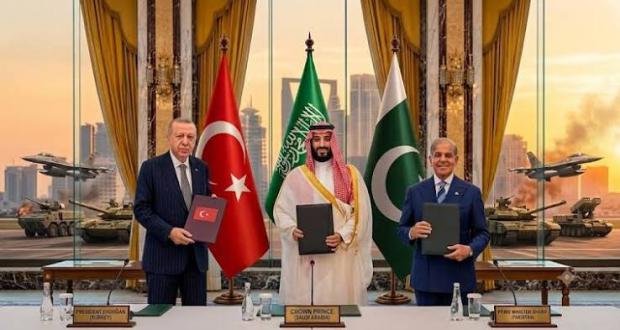
The Mecca Agreement of Pakistan, Saudi Arabia, and Turkey rests on two mutually reinforcing pillars: first, it seeks to deter an attack on any member by making clear that an attack against one will be treated as an attack against all. Second, in case an attack occurs, it promises a collective response from the three members.
Just like Nato, on which the Pakistan-Saudi-Turkey alliance is modelled, the logic is straightforward: the credibility of the promise of a collective response is what gives the deterrent its force. But the spiralling Saudi-Houthi conflict has now strained both pillars of the alliance.
As the Houthis have hammered Saudi Arabia for weeks, the pact's deterrence has failed to prevent the attacks, and the promise of a collective response is now being put to the test. And that raises a fundamental question: Are Pakistan and Turkey actually willing to follow through on their promises?
Despite rhetoric from Defence Minister Khawaja Asif, who pledged to defend Saudi Arabia by "whatever means available", Aishwaria Sonavane of the Takshashila Institution said that Pakistan faces significant political and military constraints to joining the fight.
Sonavane flagged that Pakistan is grappling with its own security challenges, such as the recent mosque blast in Khyber Pakhtunkhwa, ongoing tensions along the Durand Line with the Afghan Taliban, and near-daily attacks by Tehrik-i-Taliban Pakistan (TTP) and Baloch groups.
"The Houthis are widely seen as an Iranian proxy, and Pakistan has little incentive to open another front while it is already dealing with multiple security threats at home. This is less about nervousness and more about strategic caution. Pakistan would not want to become directly embroiled in the Saudi-Iran rivalry. Notably, while Prime Minister Sharif condemned the attack, he did not name either the Houthis or Iran, which is quite telling of Pakistan's position," said Sonavane, who heads the Pakistan programme at the Takshashila Institution.
Whether the alliance responds or not may decide the future of the Mecca pact. Why would any Muslim nation join the alliance in the future if the alliance fails to defend a founding member today?
The many constraints & contradictions of Mecca pact
Despite the alliance being hailed as an 'Islamic Nato', it was always going to be easier said than done — and not necessarily because the member-states lacked the intent but because they lacked the military integration needed to fight as a single force. Pakistan and Saudi Arabia do not have the degree of interoperability that is at the core of an alliance like Nato.