










Breaking News
 US sanctions ICC: Marco Rubio slams 'rogue court,' tribunal president blasts attack on '
 A retired USDA meat inspector said he had to replace his rubber boots every 4 months.
 The Tokenization Pitch: Turn In Your Gold And 'Unlock Utility'
 U.S. Army Bomb Plant Will Arm Eric Schmidt's Drones
Top Tech News
 Anduril's plan to save US sub edge from China's undersea surge
 Researchers Develop AI 'Mind-Reading' Tool That Reconstructs What Your Eyes See
 Video: Dexterous robot hand learns the delicate art of silk embroidery
 The computer that can read your mind:
 Seven apps. One craft
 SHOCK CASE REPORT: Advanced Alzheimer's Patient Regains Speech, Memory, Mobility...
 Most artificial limbs rely on silicone or plastic to mimic human hands.
 Flying cell tower beams phone signal to Japan from 10 miles up
 Chinese Commercial Reactor Achieves Nuclear Fusion with Clean Hydrogen-Boron Fuel
 Palmer Luckey: Autonomous Weapons Are Ancient and Why Anduril Won't Build Humanoids | EP #295



U.S. Army Bomb Plant Will Arm Eric Schmidt's Drones
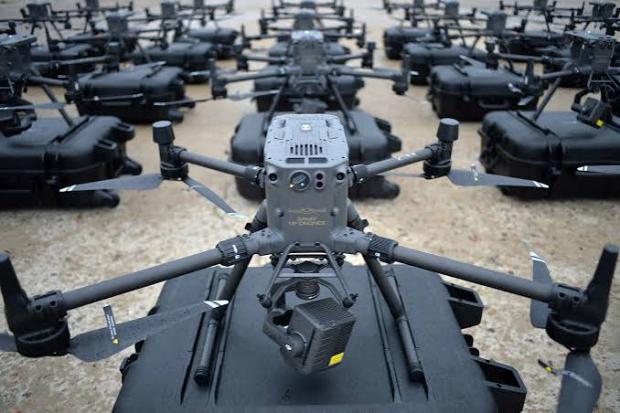
The plant held a ribbon-cutting ceremony to open the partnership, the U.S. Army said. Under the arrangement, McAlester will build, load and deliver combat-ready payloads for Perennial Autonomy's unmanned aircraft, while the company supplies the drones and their guidance systems.
The U.S. Army did not say which Perennial Autonomy drones will carry the McAlester payloads, how many will be produced, what the arrangement is worth, or when deliveries begin.
Perennial Autonomy is best known for drones that have fought in Ukraine. Schmidt started the effort in 2023, and it operated as Project Eagle before taking the Perennial Autonomy name. Will Roper, the former U.S. Air Force acquisition chief, joined the company along with engineers from Apple, SpaceX and Google. Its Merops interceptor, built around the AS-3 Surveyor drone, was developed to bring down Russian Shahed attack drones and costs roughly $15,000 per interceptor. The company says Merops has made more than 4,000 interceptions in Ukraine.
The company also makes the Bumblebee quadcopter family and the Hornet, a fixed-wing strike drone that has hit Russian logistics convoys in Ukraine at ranges beyond 100 km (62 miles).
Last month, Perennial Autonomy won the deep-strike category of Gauntlet II, the second evaluation round of the U.S. Department of War's Drone Dominance Program, scoring 80.1 points and receiving an order for 8,000 drones. The Pentagon has not published the value of that order.
In May, the Pentagon's counter-drone task force, JIATF-401, awarded the company a three-year contract with a $500 million ceiling covering Merops, Bumblebee and Hornet. U.S. Army Secretary Dan Driscoll had earlier told lawmakers the service bought 13,000 Merops interceptors in the early days of the war with Iran. Lithuania has also bought 48 Merops interceptors, joining the United States and Poland.
The plant, which falls under the U.S. Army Sustainment Command, produces, stores, ships, renovates and destroys conventional ammunition, and its workforce includes chemists, load-assemble-pack specialists and quality inspectors. Drone payloads give that workforce a new line of steady work alongside its bomb production.
The U.S. Army framed the deal as part of Army Materiel Command's push to modernize the organic industrial base, the network of government-owned arsenals, depots and ammunition plants that supply the service.