










Breaking News
 UK Sends Typhoon Jets To Support Saudis Amid Houthi Attacks
 US Pending Home Sales Collapse To Record Lows In September
 As France Burns, Media Insists It's 'Mostly Peaceful'; Blames Right-Wing Influencers
 Trump Unveils $8 Billion Harvest Fuel Relief Program To Support Farmers
Top Tech News
 Bioinspired robot airdrops into remote waters via morphing wing-sail
 Anduril interceptor adapts to emerging threats via swappable stages
 I Built a Website to Expose Solar and Battery Scams
 Whistleblower Issues Dire Warning: Rogue AI, Hacking Nuclear Programs...
 Multi-material insulation delivers up to 10,000 x the stiffness
 Anduril's plan to save US sub edge from China's undersea surge
 Researchers Develop AI 'Mind-Reading' Tool That Reconstructs What Your Eyes See
 Video: Dexterous robot hand learns the delicate art of silk embroidery
 The computer that can read your mind:
 Seven apps. One craft



A Forgotten 30 year forestry experiment produced astonishing results
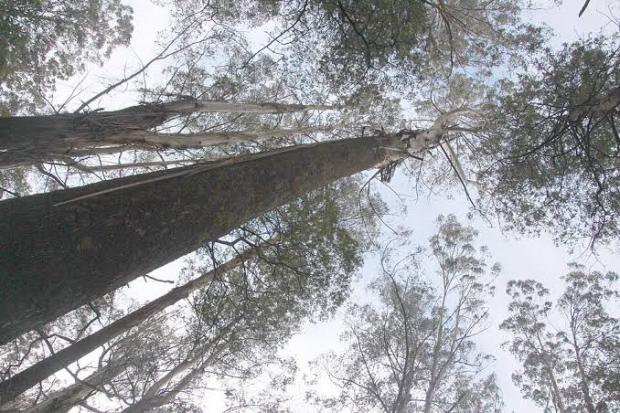
These trees were so large this forest area had regained as much carbon as the untouched areas held. More surprisingly, the only areas where they couldn't find any leadbeater possums were the unmanaged forests. It was a win-win-win all around. If the Greens cared at all about carbon "pollution" or the possums, they'd be phoning up the foresters asking if they could start thinning the native forests again.
Back in 1987 foresters in Victoria set up an experiment in Tanjil Bren where they compared the effect of many different styles of forest management. The forest at Tanjil Bren was dense mountain ash regrowth from the 1939 fires. They clearfelled small spots, larger spots, and heavily thinned some areas by as much as 50 — 70%. They also left some areas to keep growing themselves untouched.
The initial round of results in the early 2000 era looked at the speed that the Mountain Ash could regenerate — which was fastest on the clearfell areas. The heavily thinned areas grew acacia and other species in the understory. At this point: "The findings were published. The access road grew over. The project sign collapsed. The experiment was forgotten. The debates continued."
But the trees continued to grow.
Researchers went back in 2014 and were amazed
A forgotten 30-year forest experiment just delivered a huge surprise
Original written by Kaitlyn Hammond, Craig Nitschke, Patrick Baker, and Raphael Trouve.
A 30-year forestry experiment in Australia found that heavily thinned mountain ash forests grew unusually large trees while recovering enough carbon to match or exceed untouched areas. The results suggest carefully managed thinning could support timber production, wildlife habitat, and carbon storage at the same time.
In the long run.
What we found was astounding.
The original results still held: 30 years later, the mountain ash in the large cleared patches and clearfelled areas was vigorous and abundant. But it was the heavily thinned parts of the forest that really caught our attention.
The trees left behind after thinning were enormous. While they were only 80 years old, the largest averaged well over a meter in diameter at chest height, and some were more than 1.5m. Thinning had given these trees more space and resources to grow, and they had responded dramatically. The largest trees in the thinned stands were 20% bigger in diameter than those in the unharvested control areas.
More remarkable still: the thinned stands of trees had stored as much or more carbon in their wood than the unharvested control areas. In just 30 years, the heavily thinned forest had not only recovered all the carbon removed during harvesting, but had also gained enough additional carbon to equal the increase seen in the unharvested controls.