










Breaking News
 Boston Mayor Michelle Wu Paying Illegals $575 To Become 'Organizers'...
 The Steady Erosion Of The Middle Class In America Resembles A Very Twisted Game Of Musical Chairs
 Ultra Bad El Nino to kill 450,000, it's the "worst in 1,000 years"...
 Britain Apologizes For Disrupting Whatever It Was Nice Muslim Men Were Doing
Top Tech News
 Elon Musk's Next-Gen Motor Destroy Entire EV Industry
 China's disputed satellite refueling heralds new space war era
 BYD Will Put Solid-State Batteries In An EV Next Year: Executive
 FDA-cleared exoskeleton puts spinal-cord patients back on their feet
 Your Robotic Vacuum Is Watching You -- Could It Someday Testify Against You in Court?
 Why Unigrid's Sodium-Ion Batteries Are the Game-Changer for Off-Grid Energy Storage
 This Battery On Wheels Makes Any Diesel Truck Electric In 5 Minutes
 Mass-Production of AI Infrastructure – Speed Up by 10X
 3D-printed Martian mud homes look critical for life beyond Earth
 Inside The Texas Factory Racing To Break China's Grip On EV Magnets



Ultra Bad El Nino to kill 450,000, it's the "worst in 1,000 years"...
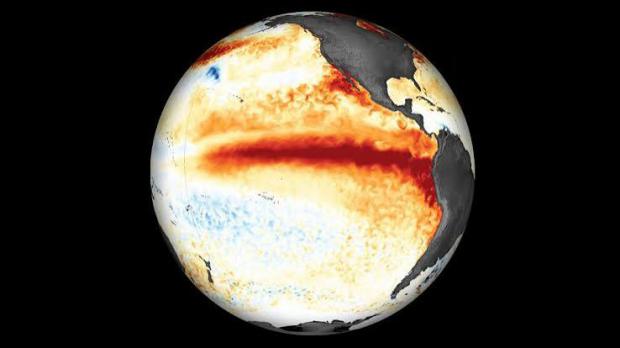
This El Nino is absolutely definitely the worst – apart from all the other ones we don't know about, which is most of them.
Satellites only started in 1979, and prehistoric records of atmospheric pressure are thin on the ground. For some reason Pacific Islanders weren't paddling out in canoes recording the sea surface temperature every day, and they certainly weren't doing it across 5,500 kilometers, which is the area we watch today.
Yet here we are, facing headlines for months about 'the worst ever' El Nino, which is going to kill 450,000 people, and it's all our fault because one study of a bunch of corals at the Galapagos found an uptick in the last 40 years.
What we really need is to find all those satellite records from the Reformation…
The Cole et al study found the holy grail of climate grants — an El Nino signal that could be construed as 'intensified' in the last forty years, which means they can loosely associate it with man-made CO2 emissions.
In the immortal words of the lead researcher, it must be CO2 because we couldn't think of anything else. It's Argument from Ignorance all the way down until it gets eaten by the turtle.
The study doesn't prove climate change is the culprit. But because the intensification coincides with rapid postindustrial warming and exceeds El Niño's natural variability, the authors argue that human-driven warming is the leading explanation. "That's the thing that has changed over that time," says Julia Cole, a paleoclimatologist at the University of Michigan who led the study. "So if I get pushback on that, I would like to know what the alternative is."
She presumably hasn't read the Wang study showing how "solar activity appears to affect a slab of water" in the North Eastern Pacific.
The Galapagos study's '1,000 year archive' is full of holes, and so is their explanation. They have about 28 time series of corals from 13 colonies at this one set of islands. They sampled the corals at millimeter intervals to give them some higher resolution, but there are gaps over the last thousand years, and they're comparing corals-as-thermometers at one point, to the high resolution temperature records of the last four decades spread across 5,000 kilometers of the Pacific?
Added to this, the gaps in coral records might not be random. If the worst El Nino years are warm and wet in the Galapagos, they might wipe out the corals. (This happened in 1982, when corals were hit hard). There could be a survivor bias where the worst years are also the ones more likely to be degraded in the records.