










Breaking News
 Your Car Was Never the Target
 JUST IN: Tucker Carlson Joins Alex Jones LIVE At 1PM CT To Break MASSIVE NEWS!
 The Evil Within, Part 1: The National-Security State
 Europeans Visiting U.S. for World Cup Fall in Love with America: 'The Most Wonderful People...**
Top Tech News
 World's first consumer wing-in-ground effect aircraft takes flight
 America's Military Readiness Depends On Deployable Nuclear Power
 License Plate Cameras Are About To Start Tracking A Lot More Than Just Your Car
 Heads up: Apparently the government is hiding cameras inside fake utility boxes
 Sodium Batteries And EVs That Power The Grid: Inside GM's Big Energy Push
 NUCLEAR ENGINE - UNLIMITED LUXURY - 20 YEARS WITHOUT REFUELING
 China Unveils Nuclear-Powered Floating Hub For Green Shipping
 China Launches World's 1st Commercial Brain Chip, Beating Elon Musk's Neuralink!
 Modular next-gen US nuclear reactor goes critical
 How EMF's cause disease


SpaceX's Starfall capsule could make military supply drops from space
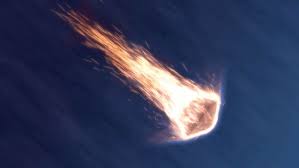
On Tuesday, June 23, after 6:43 am EDT, SpaceX plans to launch a Falcon 9 rocket from Space Launch Complex 40 (SLC-40) at Cape Canaveral Space Force Station in Florida. Since the company launches so many rockets these days, making a comment on it is hardly necessary, but this one is different because the payload is the experimental Starfall capsule.
According to documents released by the FAA, Starfall resembles a giant hockey puck. Measuring 10 ft (3 m) in diameter and 2.5 ft (75 cm) thick, the 2.1-tonne capsule is designed to carry one tonne of cargo. The top part of the capsule is made of aluminum and special thermal protection materials, while the bottom half is made of carbon fiber wrapped in a high-performance thermal protective layer.
There's no propulsion system, though there are attitude control thrusters using compressed nitrogen gas and a parachute system for reentry. To protect the cargo, the capsule is pressurized with nitrogen or some other inert gas. Since there is no onboard propulsion, Starfall remains attached to a frame while in orbit that gives it a huge boost when it's time to return to Earth.
The purpose of Starfall is two-fold.
The first is to act as a robotic orbital laboratory aimed at private businesses in the post-International Space Station era. Though nowhere near as large or versatile as the space lab, Starfall is claimed to be able to give customers access to weightlessness and vacuum for science or orbital manufacturing of precision products like crystals or drugs.
However, the second potential role is more intriguing. SpaceX sees Starfall as a way to store cargo in orbit for rapid point-to-point delivery almost anywhere in the world at very short notice. The idea is that a fleet of such capsules and their motherships could be stationed in various orbits and then deorbited on command.
Such a system would be very attractive for disaster relief and even more so for the US and allied militaries, which currently spend a great deal of time and effort maintaining supply depots around the world to prepare for future contingencies. By placing these in space, fewer such depots would be required, security problems would be all but eliminated, and dealing with host nations would not be an issue.